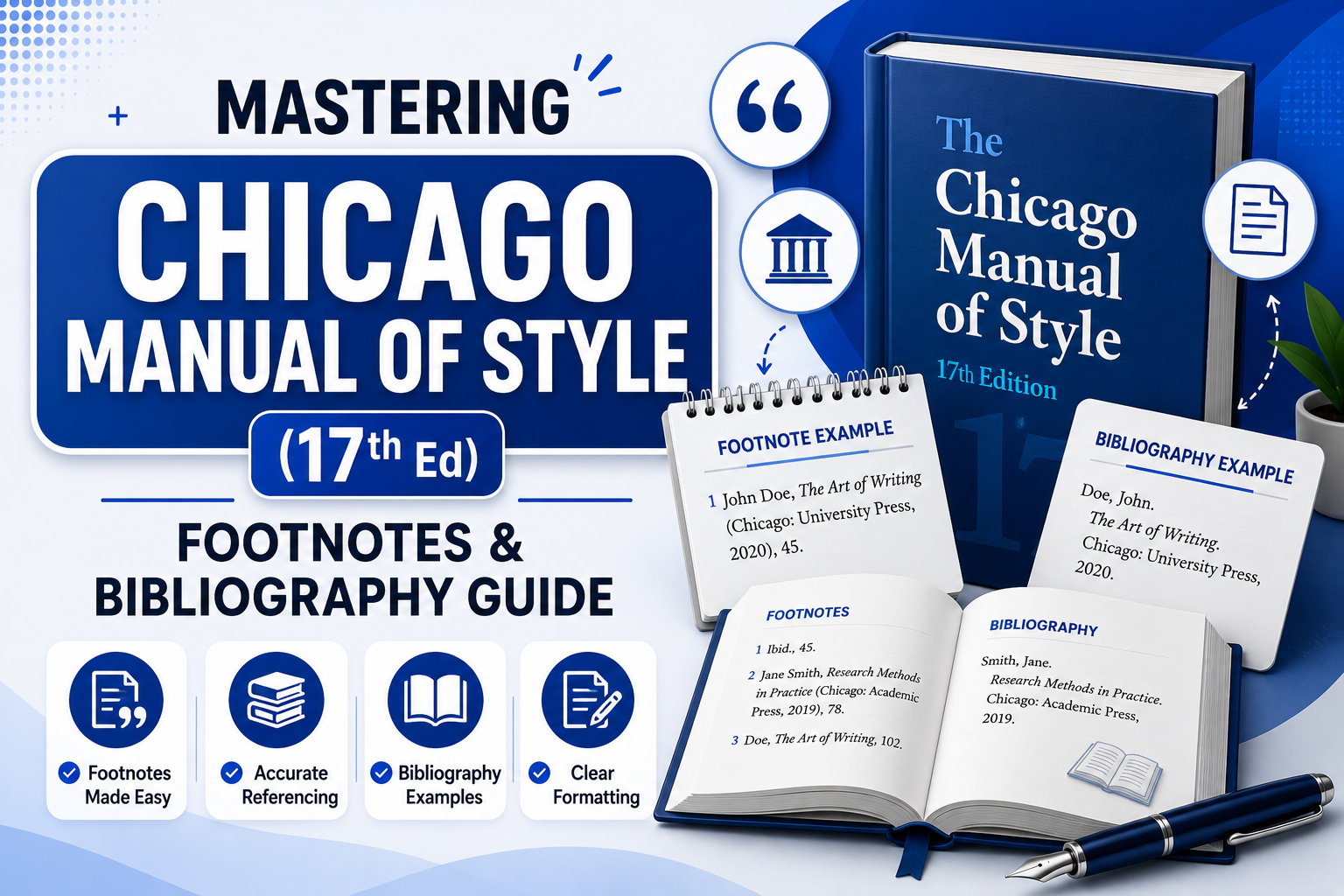
Mastering Chicago Manual of Style (17th Ed): Footnotes & Bibliography Guide
Introduction to Chicago Manual of Style (17th Edition)
The Chicago Manual of Style (CMOS), published by the University of Chicago Press, is the definitive gold standard for academic citation and editorial style across humanities disciplines—including history, art history, music, literature, religion, and philosophy. Now in its 17th edition, CMOS provides two distinct documentation formats: the Notes and Bibliography (NB) system (widely favored in humanities with superscript footnotes or endnotes and a matching bibliography) and the Author-Date system (preferred in physical and social sciences).
Mastering the Notes and Bibliography system requires an understanding of how to cite sources at the bottom of the page using numbered footnotes, as well as constructing a detailed, alphabetically arranged Bibliography at the end of your paper. This guide provides comprehensive coverage of formatting rules, footnote structures, and bibliography entries for books, journal articles, archived documents, and digital media.
Notes & Bibliography vs. Author-Date: Which System Do You Need?
Before formatting your paper, verify which Chicago citation variation your academic department requires:
- Notes-Bibliography (NB) System: Uses superscript numerals in the body text (e.g., 1) corresponding to numbered footnotes at the bottom of the page or endnotes at the end of the manuscript. This system offers immense flexibility for citing complex historical documents, archival manuscripts, and primary literature.
- Author-Date System: Uses brief parenthetical in-text citations containing author surname and year (e.g., Smith 2024, 45) backed by a Reference List. Similar to APA style.
Formatting Footnotes & Endnotes in Chicago Style
In the NB system, every time you quote, paraphrase, or reference external source material, insert a superscript numeral at the end of the clause or sentence (outside punctuation marks like periods or quotation marks). Footnotes appear at the bottom of the corresponding page, separated from body text by a short horizontal rule line.
1. Full Note vs. Shortened Note Rules
The first time you cite a source in your manuscript, provide a Full Note containing complete publication details. For all subsequent citations of the exact same source, CMOS 17th mandates using Shortened Notes (Author surname, shortened title, page number) to keep text clean and readable.
Full Note (First Citation in Manuscript):
1. Margaret Peterson, The Renaissance Mind: Art and Philosophy in Florence (Chicago: University of Chicago Press, 2021), 142–45.

Shortened Note (Subsequent Citations):
2. Peterson, Renaissance Mind, 189.
2. Discontinuation of "Ibid." in CMOS 17th Edition
A major update introduced in the 17th edition of the Chicago Manual of Style is the official discouragement of the abbreviation "Ibid." for repeated consecutive citations. Instead, writers are instructed to use shortened notes for all subsequent citations. This change eliminates ambiguity when modifying digital manuscripts.
Chicago Style Citation Examples: Footnotes vs. Bibliography
Notice the exact differences in punctuation, formatting, and author name ordering between Footnotes (N) and Bibliography entries (B):
1. Books (Single & Multiple Authors)
- Footnote (N): 1. Arthur Schlesinger Jr., The Age of Jackson (Boston: Little, Brown and Company, 1945), 67.
- Bibliography Entry (B): Schlesinger, Arthur, Jr. The Age of Jackson. Boston: Little, Brown and Company, 1945.
2. Peer-Reviewed Journal Articles (Print & Digital with DOI)
- Footnote (N): 2. Elena Rostova, "Archival Discoveries in Post-War European History," Journal of Modern History 95, no. 2 (June 2023): 310–12, https://doi.org/10.1086/724589.
- Bibliography Entry (B): Rostova, Elena. "Archival Discoveries in Post-War European History." Journal of Modern History 95, no. 2 (June 2023): 300–325. https://doi.org/10.1086/724589.
3. Websites and Digital Articles
- Footnote (N): 3. Samuel Jenkins, "Evaluating Digital Primary Sources," Academic Help, published July 14, 2024, https://youracademichelp.com/blog/chicago-style-guide.
- Bibliography Entry (B): Jenkins, Samuel. "Evaluating Digital Primary Sources." Academic Help. Published July 14, 2024. https://youracademichelp.com/blog/chicago-style-guide.
Formatting the Bibliography Page
The Bibliography appears at the end of your paper on a dedicated page labeled with the centered title Bibliography. Essential formatting rules include:
- Alphabetical Sorting: Sort entries alphabetically by author surname. If an entry has no author, alphabetize by the first word of the title (ignoring articles like "A", "An", or "The").
- Hanging Indent: Apply a 0.5-inch hanging indent to every entry.
- Line Spacing: Single-space individual entries, but insert a blank line between separate entries.
- 3-Em Dash for Repeated Authors: If citing multiple works by the exact same author, replace the author's name in second and subsequent entries with a 3-em dash (———) followed by a period.
Summary & Final Checklist
Mastering Chicago Manual of Style 17th Edition ensures your historical and humanities research adheres to flawless scholarly standards. By accurately applying superscript footnote markers, using shortened notes for subsequent citations, and maintaining a beautifully formatted Bibliography, you guarantee maximum academic rigor for your papers.