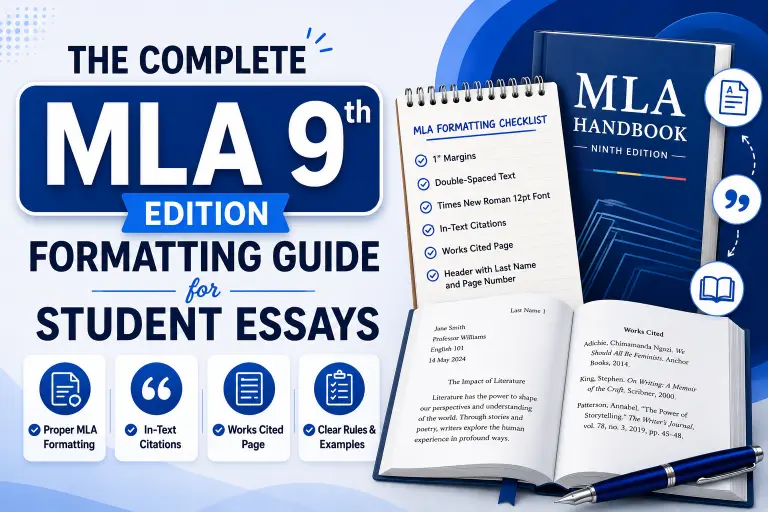
The Complete MLA 9th Edition Formatting Guide for Student Essays
Overview of MLA 9th Edition Standards
The Modern Language Association (MLA) released its 9th edition handbook in 2021, providing updated citation standards for literature, language, media, and cultural studies scholars. MLA style emphasizes clarity, conciseness, and flexible documentation for modern digital resources. Grounded in the universal concept of "containers," MLA 9th offers a unified citation framework that applies seamlessly to classical printed books, peer-reviewed journals, digital databases, podcasts, YouTube videos, and social media posts.
Whether you are composing a high school English essay or an advanced university literary critique, understanding MLA paper formatting and Works Cited container rules is essential. This detailed guide covers page setup, author-page in-text parenthetical citations, block quotation formatting, and container-based Works Cited entries.
MLA Style Paper Layout & First Page Setup
MLA format requires uniform layout specifications across the entire manuscript:
- Margins & Spacing: Standard 1-inch (2.54 cm) margins on all four sides. The entire document—including body paragraphs, block quotes, and the Works Cited page—must be double-spaced.
- Typography: Choose a clear font like 12-point Times New Roman or 11-point Arial.
- Running Head: Include your last name followed by the page number in the top-right header of every page, 0.5 inches from the top edge (e.g.,
Smith 1). - First Page Header Block: MLA does not require a cover title page unless specifically requested by your instructor. Place a flush-left header in the upper-left corner of page 1 containing: Your Full Name, Instructor's Name, Course Name/Number, and Assignment Date (formatted Day Month Year: e.g.,
24 October 2026). - Essay Title: Center your essay title below the header block in plain text (no bolding, underlining, or quotation marks).
MLA In-Text Citations (Author-Page System)
MLA uses an author-page parenthetical citation format. Do not place a comma between the author's last name and the page number, and do not use "p." or "pp."
1. In-Text Parenthetical & Narrative Examples
- Parenthetical Citation: Literary symbolism enhances thematic depth (García 88).
- Narrative Citation: According to García, literary symbolism enhances thematic depth (88).
- Two Authors: (García and Zhao 104)
- Three or More Authors: Cite the first author's last name followed by "et al." (e.g., Bennett et al. 45).
2. Block Quotation Formatting
When quoting prose exceeding four lines (or poetry exceeding three lines), format the quote as a standalone block quote. Indent the entire block 0.5 inches from the left margin, maintain double-spacing, omit quotation marks around the block, and place the parenthetical citation after the closing punctuation mark.
The MLA 9th Nine Core Elements & Container System
MLA 9th structures entries in the Works Cited list using a universal template of nine core elements in a fixed order, followed by correct punctuation:
MLA 9th Nine Core Elements Template:
1. Author. (Last Name, First Name)
2. Title of Source. (in italics for books, in quotes for articles/chapters)
3. Title of Container, (italics)
4. Contributor, (e.g., edited by, translated by)
5. Version, (e.g., 2nd ed., revised ed.)
6. Number, (e.g., vol. 12, no. 4)
7. Publisher,
8. Publication Date,
9. Location. (page numbers like pp. 45-50, DOI, or URL)
Works Cited Examples
- Book: Morrison, Toni. Beloved. Vintage Books, 2004.
- Journal Article in Database: Rodriguez, Maria. "Poetic Realism in Modern Drama." Modern Fiction Studies, vol. 68, no. 2, 2022, pp. 145-68. JSTOR, https://doi.org/10.1353/mfs.2022.0019.
- Web Article: Albright, David. "Rhetorical Strategies in Digital Essay Writing." Academic Help, 18 Aug. 2024, https://youracademichelp.com/blog/mla-formatting-guide.
Formatting the Works Cited Page
Append your Works Cited list to the end of your essay on a new page. Center the title Works Cited at the top. Alphabetize entries by author last name, double-space all lines, and apply a 0.5-inch hanging indent to every entry.
Summary & Final Checklist
By applying MLA 9th author-page in-text citations, setting up a proper double-spaced layout with right-aligned headers, and structuring your Works Cited list using the 9 Core Elements container method, you create clean, professional humanities essays that satisfy university standards.