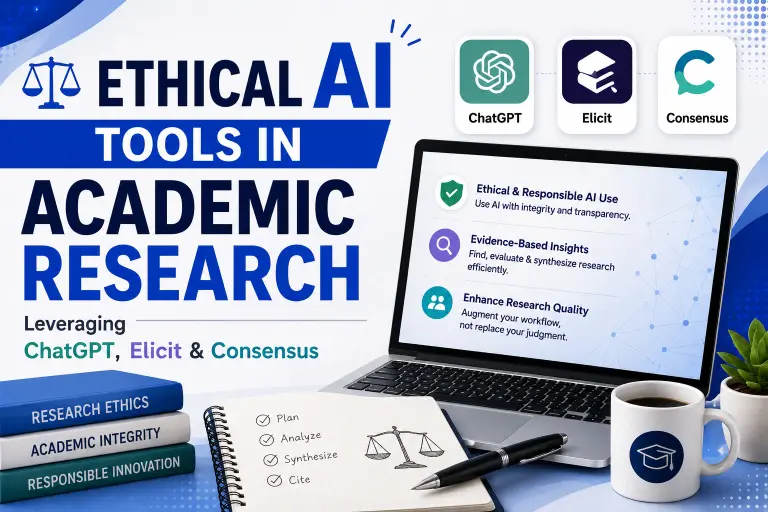
Ethical AI Tools in Academic Research: Leveraging ChatGPT, Elicit & Consensus
The Generative AI Revolution in Academic Research
Artificial Intelligence is transforming how scholars discover, analyze, synthesize, and edit academic literature. Specialized AI research assistants—such as Elicit, Consensus, Scite.ai, and ChatGPT—can analyze thousands of peer-reviewed papers in seconds, extract key methodological parameters, summarize research findings, and identify literature gaps with unprecedented speed.
However, integrating generative AI into academic research introduces significant ethical responsibilities. Misusing AI tools can lead to fabricated citations (AI hallucinations), institutional policy violations, unintentional plagiarism, and intellectual property risks. This guide explores the ethical usage boundaries, capabilities, and best practices for leveraging AI research assistants without compromising academic integrity.
1. Specialized AI Literature Discovery Tools
Unlike general-purpose conversational LLMs, specialized AI academic tools query indexed databases of peer-reviewed literature (such as Semantic Scholar and PubMed), providing direct citations for every output.
Top AI Research Assistants
- Elicit.com (The AI Research Assistant): Uses language models to search peer-reviewed papers directly. Elicit extracts key research questions, sample sizes, methodologies, and core findings into structured summary matrices.
- Consensus.app (AI Search Engine for Research): Queries over 200 million academic papers to answer specific research questions with a synthesized "Consensus Meter" showing agreement levels across published studies.
- Scite.ai (Smart Citations): Evaluates how a specific research paper has been cited by subsequent authors, classifying citations into supporting evidence, contrasting evidence, or simple mentioning citations.
2. Ethical Boundaries: What AI Should and Should Not Do
Ethical AI Use Cases (Permitted & Encouraged)
- Brainstorming & Query Construction: Generating Boolean search strings, synonym lists, or alternative research topic perspectives.
- Literature Discovery: Finding relevant peer-reviewed papers across multidisciplinary databases using natural language prompts.
- Language Proofreading & Grammar Editing: Using AI to improve sentence flow, clarity, and grammatical correctness for ESL (English as a Second Language) researchers.
- Code Debugging: Debugging R, Python, or SPSS statistical syntax scripts.
Unethical AI Use Cases (Prohibited Violations)
- Generative Content Ghostwriting: Prompting AI to write complete thesis chapters or essay paragraphs verbatim and submitting them as original work.
- Falsifying Citations: Citing non-existent papers generated by LLM hallucinations without verifying original source PDFs.
- Fabricating Data Analyses: Using AI to generate artificial survey data or manipulate statistical results.
- Uploading Confidential Datasets: Inputting unpublished participant data or proprietary manuscripts into public LLMs, violating IRB privacy mandates.
3. University Policy Compliance & AI Disclosure Statements
Major university departments and peer-reviewed journals (such as Nature, Science, and Elsevier) mandate explicit disclosure regarding AI usage. Always include an AI Transparency Statement in your manuscript methodology section or acknowledgments block:
Sample AI Disclosure Statement:
"During the preparation of this manuscript, the authors utilized ChatGPT (GPT-4) strictly for grammar refinement and improving sentence clarity. All original ideas, literature analysis, data collection, statistical computations, and critical conclusions were executed independently by the authors. The authors reviewed and edited all AI-assisted language outputs and take full responsibility for the content of this publication."
Summary & Ethical Checklist
AI research assistants are powerful force multipliers for literature discovery and editing when used responsibly. Treat AI tools as research assistants rather than authors, verify all source citations independently, and maintain total transparency regarding tool usage to protect your academic reputation.
Advanced Prompt Engineering for Academic Literature Discovery
Unlocking the full potential of AI research assistants requires mastering structured prompt engineering. When querying tools like ChatGPT, Claude, or Elicit for literature analysis, avoid vague questions. Use role-based, constrained prompt templates:
Academic Prompt Blueprint:
"Act as a senior educational psychology researcher. Review the following text snippet from a peer-reviewed study. Summarize:
1. Primary independent and dependent variables
2. Main statistical limitations
3. Potential confounding factors
Maintain a formal, objective academic tone. Do not introduce unverified external claims."
Evaluating AI Hallucinations & Verification Protocols
Large Language Models (LLMs) operate probabilistically, meaning they can generate plausible-sounding but entirely fabricated citations, page numbers, and study outcomes. Establish a strict Verification Protocol: never include an AI-suggested paper in your reference list without downloading and inspecting the original full-text PDF yourself.
Institutional Review Board (IRB) Data Privacy Rules
Never input unpublished human subject transcripts, confidential participant survey responses, or proprietary institutional data into public AI chatbots. Public models may use input prompts for model retraining, violating participant privacy agreements and IRB regulations.
AI-Assisted Literature Mapping & Citation Network Visualizations
Emerging AI tools like ResearchRabbit, Connected Papers, and Litmaps utilize machine learning algorithms to visualize citation networks. Inputting a single seed paper generates interactive visual graphs connecting co-cited publications, foundational ancestor papers, and recent derivative studies.
Integrating citation network mapping into your early literature discovery workflow prevents missing critical landmark studies and illuminates implicit academic debates across international research cohorts.
Best Practices for Citation Auditing & Plagiarism Prevention
To maintain impeccable academic integrity when utilizing AI writing assistants for editing, process your draft through plagiarism detection engines (such as Turnitin or iThenticate) prior to submission. Confirm that all direct quotes are enclosed in quotation marks and properly cited to avoid unintentional similarity flags.