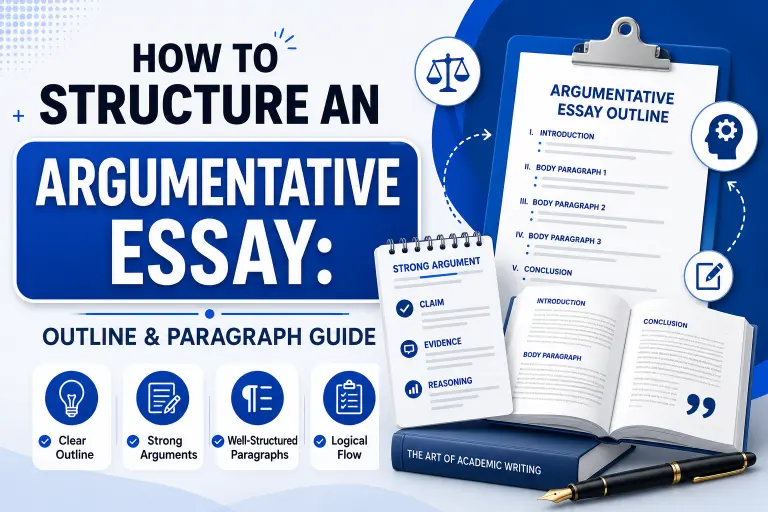
How to Structure an Argumentative Essay: Outline & Paragraph Guides
Understanding the Architecture of an Argumentative Essay
An argumentative essay is a cornerstone of academic inquiry and intellectual debate. Unlike descriptive essays that summarize information or narrative essays that retell personal experiences, an argumentative essay requires writers to thoroughly investigate a contentious issue, synthesize diverse empirical evidence, formulate a decisive stance, and persuade readers through structured logical reasoning. Mastering the architectural design of an argumentative paper is essential for achieving academic excellence across humanities, social sciences, and STEM disciplines.
The secret to crafting a high-scoring argumentative essay lies in structural transparency. Readers, professors, and peer reviewers should never have to guess where your argument is heading or how individual body paragraphs connect back to your overarching claims. By establishing a methodical outline that balances claim presentation, evidence integration, analytical unpacking, counterargument refutation, and logical synthesis, you ensure your arguments resonate persuasively and stand up to rigorous scrutiny.
Comprehensive Step-by-Step Essay Outline
Before drafting body paragraphs, developing a comprehensive outline guarantees logical flow and prevents structural drift. A classical 5-to-7-paragraph argumentative outline consists of four primary structural divisions:
1. The Introduction (Hook, Context & Thesis Statement)
The introduction paragraph captures reader attention, establishes real-world relevance, provides key background context, and culminates in a sharp, debatable thesis statement:
- The Attention Hook: Open with a provocative statistic, an insightful quote from a prominent scholar, a compelling rhetorical question, or a brief real-world scenario. Avoid clichés like "Throughout history..."
- Background Context: Define specialized terminology, summarize the current state of scholarly debate, and narrow the conversational scope down to your precise essay topic.
- The Thesis Statement: Positioned at the end of the introductory paragraph, your thesis statement is the single most vital sentence in your essay. It must take a clear position and outline your key supporting claims (e.g., "While critics argue that artificial intelligence threatens academic integrity, higher education institutions should integrate AI literacy into core curricula because it improves research efficiency, prepares students for modern workforce demands, and promotes equitable access to personalized learning tools.").
2. Body Paragraph Architecture (The MEAL Plan Framework)
Every body paragraph must dedicate itself to proving a single supporting claim. Utilize the MEAL plan framework to guarantee analytical depth in every section:
- M - Main Idea (Topic Sentence): Formulate a strong, clear topic sentence in the first line of the paragraph that introduces your specific supporting claim and links directly back to the thesis statement.
- E - Evidence: Incorporate high-quality empirical evidence, peer-reviewed study results, expert testimony, or historical case studies. Always attribute source material accurately using standard citation styles (APA, MLA, or Chicago).
- A - Analysis: Unpack the evidence thoroughly. Do not assume the evidence speaks for itself. Explain *why* the data matters, *how* it proves your topic sentence, and *why* it supports your overarching thesis. Analysis should comprise at least 50% of the paragraph's word count.
- L - Lead-in / Link: Summarize the core takeaway of the paragraph and transition smoothly into the subsequent argument.
3. Counterarguments & Systematic Rebuttals
What separates an adequate essay from an exceptional piece of scholarship is how effectively it handles opposing viewpoints. A strong argumentative paper demonstrates academic maturity by presenting opposing arguments fairly before systematically dismantling them with superior evidence and logical analysis.
Counterargument Paragraph Template:
1. Present the Opposing Viewpoint Fairly: "Skeptics contend that..." or "Opponents argue that..."
2. Concede Valid Points: "While it is true that [minor valid point], this view overlooks..."
3. Deliver the Analytical Rebuttal: "Recent empirical data demonstrates that..."
4. Reassert Thesis Strength: "Consequently, the objection fails to undermine the broader necessity of..."
4. The Conclusion (Synthesis & Real-World Implications)
Avoid simply repeating your introductory paragraph word-for-word. The conclusion must synthesize your body paragraph findings, showing how your claims interconnect to prove your central thesis. Conclude with a memorable final thought, a call to action, or a reflection on the broader societal implications of your argument.
Comparing Aristotelian, Toulmin, and Rogerian Argument Models
Depending on your target audience and the controversial nature of your topic, select one of three classic rhetorical models:
- Classical (Aristotelian) Model: Best suited for direct, persuasive essays where your objective is to convince an audience that your argument is unequivocally superior. Employs ethos (credibility), pathos (emotion), and logos (logic).
- Toulmin Model: Highly effective for complex, highly detailed academic topics. Deconstructs arguments into Claims, Data, Warrants (underlying assumptions), Backing, Qualifiers, and Rebuttals.
- Rogerian Model: Recommended for highly polarized disputes. Focuses on establishing common ground, acknowledging valid counter-perspectives, and proposing a balanced, compromise-driven solution.
Mastering Rhetorical Transitions & Cohesion
Smooth transitions hold your essay together, guiding the reader effortlessly from one complex point to the next. Avoid repetitive transition words like "Furthermore" or "In addition." Instead, implement context-aware transitions:
- For Contrast & Rebuttal: "Conversely," "Notwithstanding these assertions," "On the other hand," "Despite these observations."
- For Causal Logic: "Consequently," "It follows that," "As a direct result," "Hence."
- For Evidence Integration: "To illustrate this phenomenon," "Empirical evidence indicates," "Case studies highlight."
Summary & Pre-Submission Checklist
By structuring your argumentative essay around a precise thesis statement, MEAL body paragraphs, well-reasoned counterargument rebuttals, and smooth rhetorical transitions, you transform raw research into a powerful academic paper. Always proofread for clarity, tone, and formatting consistency before final submission.