How to Write a Thesis Statement: Formula, Examples & Common Mistakes
What is a Thesis Statement and Why is it Essential?
A thesis statement is the intellectual foundation of any successful academic essay, analytical report, or argumentative dissertation. Typically positioned near the end of your introduction paragraph, a thesis statement summarizes your central claim, articulates your unique stance on a topic, and provides a clear structural roadmap for your readers. Without a razor-sharp thesis statement, an essay risks devolving into a fragmented list of summary points rather than a persuasive argument.
Whether you are composing an argumentative paper, an expository explanation, or an analytical critique, mastering thesis construction is the single most vital skill you can develop as an academic writer. This comprehensive guide breaks down proven thesis formulas, real-world examples across academic genres, and methods to fix weak or overly broad thesis claims.
The Classic Thesis Formula & Architecture
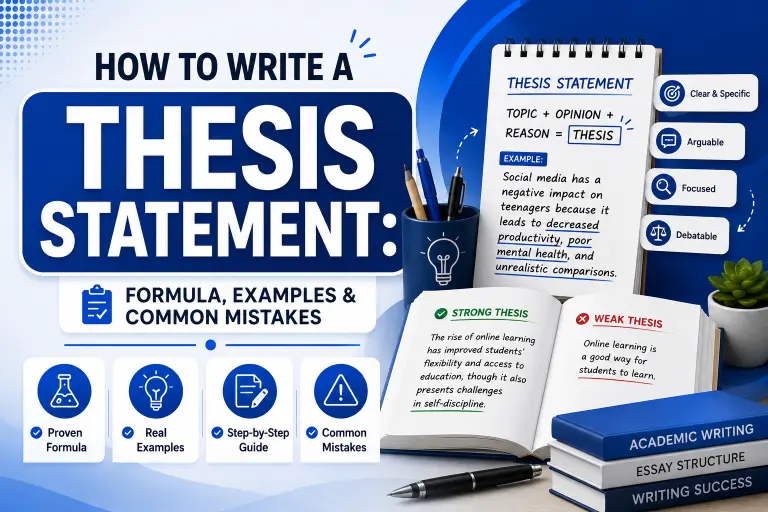
A strong thesis statement goes beyond declaring a topic—it pairs a specific, debatable claim with reasoned supporting points. Use this primary formula:
The Master Thesis Formula:
[Specific Topic] + [Debatable Claim / Stance] + BECAUSE [Reason 1], [Reason 2], and [Reason 3].

Advanced Counterargument Formula:
Although [Counter-argument or Concession], [Your Stance] because [Primary Reason 1] and [Primary Reason 2].
Thesis Statement Types & Examples Across Genres
1. Argumentative Thesis Statement
An argumentative thesis takes a decisive side on a controversial issue and aims to convince the audience through empirical evidence.
Example: "While traditional letter grades motivate some students, secondary education institutions should adopt competency-based portfolio assessments because portfolios foster deep conceptual understanding, accurately measure practical skill application, and reduce severe academic anxiety."
2. Expository (Explanatory) Thesis Statement
An expository thesis explains a complex topic to the audience without taking a controversial stance.
Example: "The rapid expansion of remote tele-health platforms during the past decade transformed patient care by expanding rural access to specialist physicians, lowering emergency room admissions, and necessitating updated patient privacy regulations."
3. Analytical Thesis Statement
An analytical thesis breaks an issue or literary text down into key components and evaluates how those parts interact.
Example: "An analysis of Shakespeare’s Macbeth reveals that the protagonist’s downfall is driven not by fate, but by unchecked personal ambition, domestic psychological pressure, and ethical self-deception."
Common Thesis Mistakes & How to Fix Them
- Mistake 1: Stating a Fact Instead of an Argument.
Weak: "Pollution is bad for the environment."
Revised: "Governments must enforce stricter carbon taxes on corporate manufacturers because market-driven incentives are insufficient to curb industrial pollution." - Mistake 2: Making Overly Broad Statements.
Weak: "Social media has many positive and negative effects."
Revised: "Although social media enhances global peer communication, excessive usage among teenagers correlates with sleep disruption, reduced attention spans, and increased rates of social anxiety." - Mistake 3: Framing the Thesis as a Question.
Weak: "Should artificial intelligence be banned in college essays?"
Revised: "Higher education institutions should regulate rather than ban generative AI tools, establishing clear ethical usage boundaries that preserve critical thinking."
Testing Your Thesis: The "So What?" Test
Once you draft your thesis statement, evaluate it using the "So What?" test. Ask yourself: Why does this argument matter? If a reader responds with "So what?", refine your statement to highlight its real-world significance, scholarly relevance, or broader societal implications.
Summary & Final Checklist
A stellar thesis statement is arguable, specific, concise, and focused. By utilizing structured thesis formulas, tailoring your claim to your paper's genre, and avoiding factual or overly broad statements, you establish a solid foundation for an outstanding academic essay.