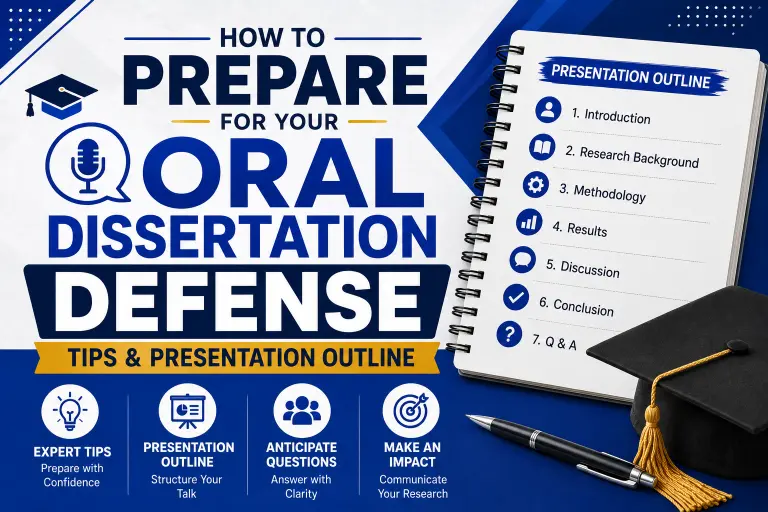
How to Prepare for Your Oral Dissertation Defense: Tips & Presentation Outline
Demystifying the Oral Dissertation Defense
The oral dissertation defense (or viva voce) is the culminating capstone of graduate education. After years of literature synthesis, data collection, statistical modeling, and manuscript revisions, candidate scholars must stand before an examination committee of expert professors to present, justify, and defend their original research.
While the idea of defending your research can feel intimidating, understanding committee expectations transforms the defense from an intimidating interrogation into a scholarly celebration of your expertise. Remember: by the time you reach defense day, you are the world's leading expert on your specific dissertation topic. This comprehensive guide details slide deck presentation structure, committee question strategies, and defense day execution.
The Standard Defense Presentation Outline (20-30 Minutes)
Most graduate defenses allow 20 to 30 minutes for presentation, followed by 45 to 60 minutes of committee Q&A. Structure your slide deck (aiming for 18 to 24 clean slides) using this proven outline:
Defense Presentation Slide Architecture:
----------------------------------------------------------------------------------
Slide Number    Section Title                 Key Focus / Content
----------------------------------------------------------------------------------
Slide 1         Title & Candidate Info        Title, Name, Advisor, Committee Names
Slide 2         Research Problem & Hook       Real-world & Theoretical Significance
Slide 3         Research Gap                  Unaddressed void in current literature
Slide 4         Research Questions / Hypotheses Precise empirical goals of study
Slides 5–6      Theoretical Framework         Core foundational theories utilized
Slides 7–9      Methodology & Design          Sample, Data tools, Analytical steps
Slides 10–16    Key Results & Findings        Core data tables, figures, key findings
Slides 17–19    Discussion & Synthesis        Interpretation in light of prior research
Slide 20        Study Limitations             Transparent methodological constraints
Slides 21–22    Theoretical & Policy Impact   Novel academic contribution & practice
Slide 23        Conclusion & Acknowledgments  Final takeaway & committee appreciation
----------------------------------------------------------------------------------
Anticipating Common Committee Defense Questions
Committee questions generally fall into four distinct scholarly categories. Preparing structured responses to these categories ensures poise during Q&A:
1. Methodological Justification Questions
- "Why did you select this specific qualitative/quantitative design instead of X?"
- "How did you address potential sample bias or non-response error?"
- "Why did you choose this sample size, and how did you verify statistical power?"
2. Theoretical Interpretation Questions
- "How do your empirical findings challenge or support [Primary Author's] theoretical framework?"
- "What was the most surprising or unexpected finding in your data analysis?"
3. Limitations and Self-Critique Questions
- "Looking back, if you were to restart this study today, what would you do differently?"
- "What are the primary boundary conditions of your findings?"
4. Future Directions & Significance Questions
- "What are the immediate practical or policy implications of your research?"
- "Where do you plan to take this research project next?"
Proven Strategies for Handling High-Pressure Q&A
Implement these professional communication techniques during the questioning period:
- Pause and Take Notes: Have a notepad ready. Write down complex multi-part questions before responding to ensure you address every component thoroughly.
- Never Feign Answers: If asked about an obscure paper or variable you did not examine, be honest: "That is an excellent point. I did not evaluate that specific variable in this study, but it represents an important area for future research."
- Defend Without Being Defensive: View committee feedback as collaborative intellectual discussion rather than personal attack. Accept valid critiques gracefully.
Summary & Defense Checklist
Preparation is the key to a calm, successful thesis defense. Practice your presentation multiple times with peers, anticipate committee questions, prepare backup slides for extra data tables, and approach your defense day with confidence.
Simulated Mock Defenses & Visual Slide Optimization
The most effective way to eliminate defense anxiety is conducting at least two timed mock defenses with fellow graduate students, post-docs, or lab colleagues. Have your mock audience ask tough questions, challenge methodological assumptions, and critique slide clarity.
Visual Slide Design Best Practices
- High Contrast & Large Typography: Use dark text on light backgrounds with minimum 24pt body font and 36pt title font for maximum room visibility.
- One Key Concept Per Slide: Avoid cluttering slides with dense paragraphs. Use concise bullet points, high-resolution figures, and bold takeaway callouts.
- Backup Data Appendix Slides: Create 10 to 15 additional slides following your conclusion containing detailed statistical output tables, instrument surveys, and secondary analyses to answer niche committee questions during Q&A.
Post-Defense Revisions & Final Sign-Off Workflows
Following a successful defense, examination committees typically assign "Minor Revisions" or "Major Revisions." Establish a clear post-defense revision strategy:
- Create a Committee Revision Matrix: List every committee member request in a spreadsheet, outline planned modifications, track manuscript page numbers, and submit the response sheet to your committee chair for final degree sign-off.
Mental Preparation & Day-of Defense Logistics
Physical and mental preparation in the 48 hours leading up to your oral defense is just as important as slide preparation. Get adequate sleep the night before, eat a balanced meal, and arrive at the defense venue or log into the virtual conference room at least 30 minutes early to test audiovisual equipment, slide clickers, and display connections.
During the defense presentation, maintain steady eye contact with your committee members, speak at a measured pace, and use clear visual transitions between slides. Remember that committee questions are designed to test the boundaries of your knowledge, not to humiliate you. Welcome challenging questions as intellectual dialogue among peer scholars.
Post-Defense Administrative Finalization
Immediately following your defense presentation and Q&A session, the committee will ask you and any audience members to leave the room so they can deliberate privately. Upon returning, the committee chair will announce the result (e.g., Pass with Minor Revisions). Obtain explicit guidance from your advisor regarding the required timeline for completing committee revisions and securing final institutional approval signatures.